
Differences between Class A and Class B Desiccants according to DIN 55473 Standard
Technical differences between Class A and Class B desiccants according to DIN and international standards
Desiccant according to DIN standards is an essential component of humidity control in industrial packaging, especially during transport and prolonged storage. DIN 55473 establishes precise technical requirements for industrial desiccants, including a key differentiation between Class (type) A and Class (type) B, based on the dust permeability of the bag and the possible escape of desiccant content. This approach is in line with other international reference standards, such as the American MIL-D-3464E and the French NFH 00-321, which also regulate the behavior of desiccants and their packaging to minimize contamination risks.
The Role of Desiccant According to DIN Standard in Industrial Packaging
In industrial applications, desiccant bags are placed inside packaging with low water vapor permeability, while the desiccant bag must be vapor permeable to allow moisture absorption. However, this permeability must not involve the release of dust or particles that could contaminate the product.
For this reason, technical standards not only evaluate moisture absorption, but also the integrity of the bag, particle emission, and compatibility with sensitive products. On this point, DIN 55473 conceptually converges with MIL-D-3464E and NFH 00-321, although each uses its own terminology and classification system.
DIN 55473 (2008 revision) defines a desiccant bag as “a system consisting of a desiccant material with controlled hygroscopic properties and a wrapper that allows water vapor to pass through but limits the escape of particles.”
This approach is not unique to Europe. The MIL-D-3464E standard, widely used in military and industrial logistics, introduces the concept of “unit desiccant” and classifies desiccants by type, based on the material (activated clay, silica gel, molecular sieve) and the degree of protection provided by the packaging. For its part, the French NFH 00-321 regulates the use of desiccants in airtight packaging, paying particular attention to internal cleanliness and the absence of solid contamination.
Technical Differences Between Class A and Class B Desiccant According to DIN 55473
Despite their formal differences, DIN 55473, MIL-D-3464E, and NFH 00-321 share a common technical core characterized by the control of moisture absorption capacity, the definition of standardized desiccant units, mechanical strength testing of the bag, assessment of the risk of particle release, and requirements for marking, supply, and traceability.
DIN 55473 expresses capacity in Desiccant Units (DU), while MIL-D-3464E uses equivalent desiccant units depending on the material. Although less explicit in terms of units, NFH 00-321 requires comparable functional results under defined test conditions.
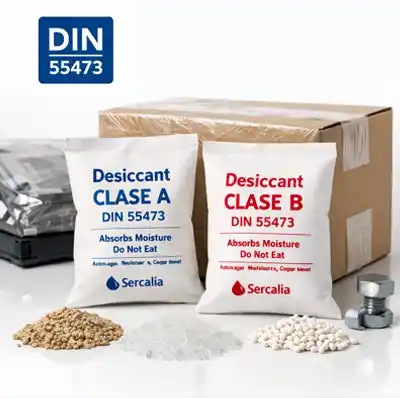
According to DIN 55473, the technical differences between Class A and Class B desiccants mainly concern the degree of dust permeability of the bag and, therefore, the level of protection against the release of particles during handling and use in industrial packaging.
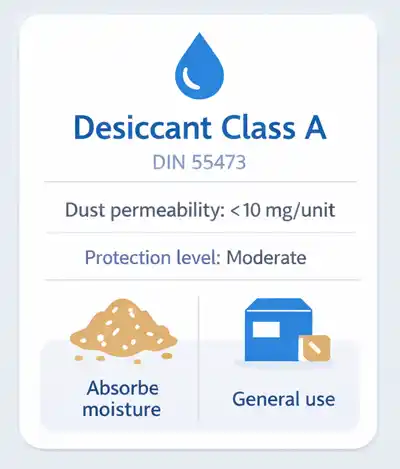
Class A desiccant is defined as having limited dust permeability. Technically, the standard stipulates that the maximum permissible emission is 10 mg of dust per Desiccant Unit (mg/DU). This value is determined by a standardized test consisting of subjecting the bag to repeated drops and then collecting the released dust. The absorbent material contained inside can be granular or particulate, but the bag is designed to restrict the escape of solid material. For this reason, Class A desiccant is suitable for general industrial packaging applications where minimal particle emission is acceptable and there is no strict requirement for internal cleanliness.
From a regulatory standpoint, this level of protection is comparable to the standard types covered by MIL-D-3464E for heavy-duty packaging, as well as certain applications covered by NFH 00-321 where the desiccant does not come into direct contact with particularly sensitive surfaces.
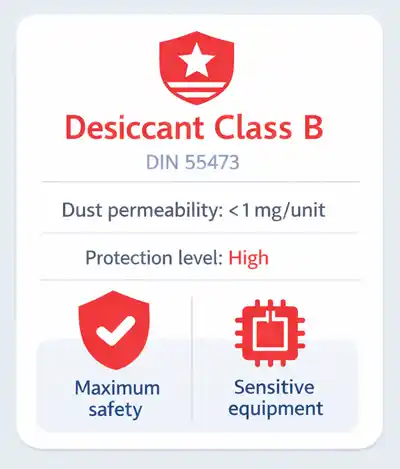
Class B desiccant represents the most demanding level within the DIN 55473 classification in terms of dust control. In this case, the bag must be virtually airtight, with a maximum emission limit of 1 mg of dust, regardless of the number of Desiccant Units used. The test method is the same as for Class A, based on repeated drops and dust collection, but the acceptance threshold is significantly stricter.
From a technical and functional point of view, Class B desiccant aligns with the more stringent requirements of MIL-D-3464E for the protection of sensitive equipment, and with the philosophy of the NFH 00-321 standard applied to sectors where internal contamination is not acceptable, such as electronics, optics, precision instrumentation, or defense.
Technical Criteria for Selecting the Appropriate Desiccant in Industrial Packaging
On the other hand, a central and often misunderstood aspect is that DIN 55473 does explicitly consider the possible leakage of the contents. It therefore requires mechanical resistance tests, which are based on repeated drops from 3 meters, alternating sides without the bag breaking or allowing visible leakage of the material.
This approach is consistent with MIL-D-3464E, which also subjects bags to severe handling tests, and with NFH 00-321, which requires the integrity of auxiliary packaging during the logistics cycle.
The correct choice between Class A and Class B affects not only regulatory compliance but also product safety. A desiccant that releases dust can cause:
- Functional or aesthetic contamination.
- Rejections in quality controls.
- Contractual non-compliance in exports.
Therefore, in professional practice, the desiccant according to DIN standard is specified by combining:
- Capacity (DU or equivalent units).
- Bag type (A or B).
- Reference standard (DIN, MIL, or NFH, depending on the market).
Logistical globalization is driving functional convergence between standards. It is increasingly common for the same product to declare compliance with DIN 55473, MIL-D-3464E, and NFH 00-321, demonstrating that it meets the most demanding requirements for absorption and internal cleanliness.
This trend reinforces the role of Class B desiccant in critical applications, without displacing Class A, which remains an efficient and compliant solution for standard industrial packaging.
The differences between Class A and Class B desiccants according to DIN 55473 are based on an essential technical criterion: the emission of particles from the contents through the bag. This approach is consistent with international standards such as MIL-D-3464E and NFH 00-321, which pursue the same objective: to ensure effective moisture control without compromising the integrity or cleanliness of the packaged product. Understanding this classification allows for the correct selection of desiccant according to the DIN standard and ensures reliable and compliant industrial packaging.

CONTACT US
We are characterised by our attention, flexibility, speed and reliability in deliveries. The best personalised service with a reliable supplier for regular supplies.