
Chocolate temperature control: the industry turns to WarmMark indicators to protect product quality
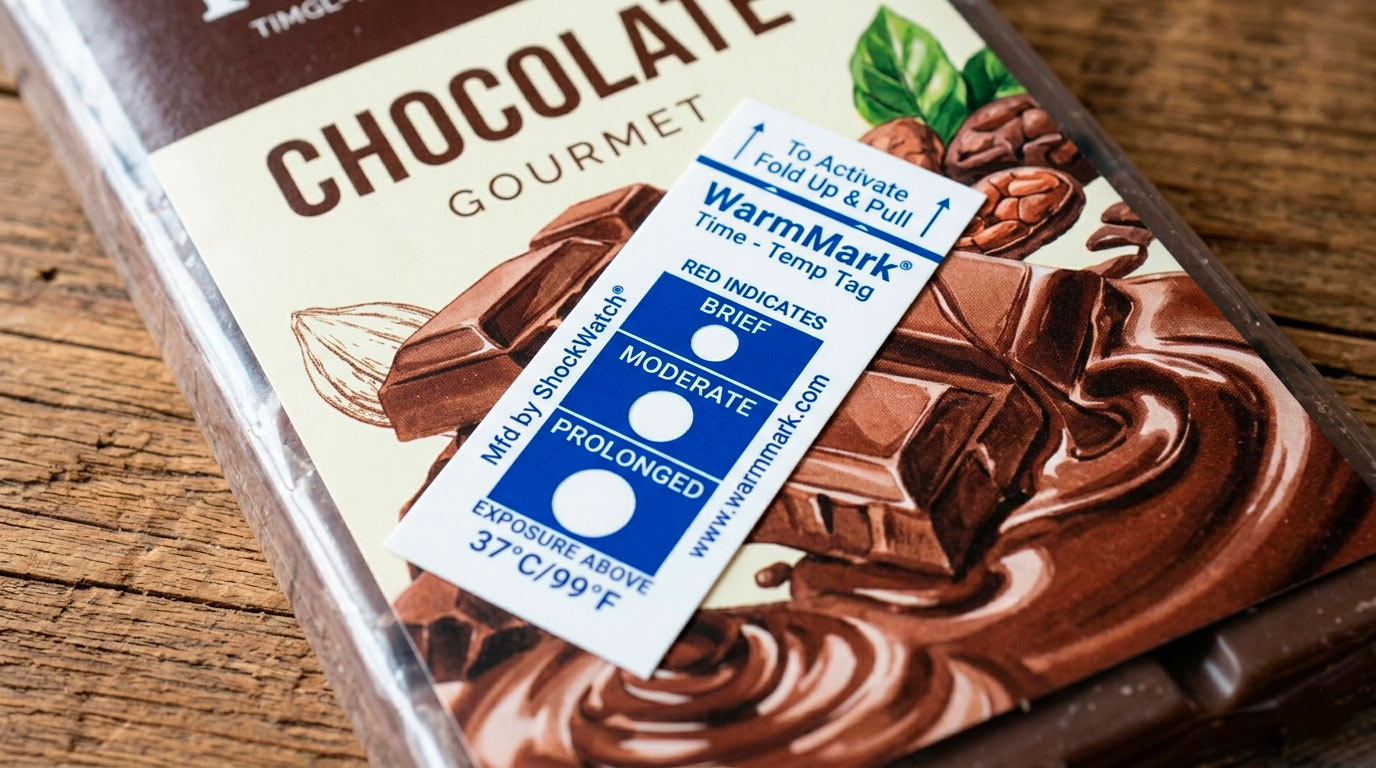
Chocolate temperature control has become a critical factor for confectionery manufacturers and distributors worldwide. In a context of global transport and rising temperatures, the industry is adopting WarmMark indicators to monitor chocolate temperature during transport, reinforce the food cold chain and ensure chocolate quality from factory to consumer.
Chocolate is one of the most heat‑sensitive foods in the food industry. Depending on its composition, it begins to soften at 26–28 °C and can lose its structure between 30 °C and 34 °C. When this happens, issues such as melting, deformation or so‑called fat bloom occur — a recrystallisation of fats that affects the product’s texture and appearance.
For this reason, chocolate temperature control has become essential throughout the entire logistics chain. From factory storage to international distribution, companies must guarantee stable thermal conditions to preserve product quality.
In this context, many companies in the sector have started using WarmMark indicators, devices designed to detect whether a product has been exposed to temperatures above a predefined limit during transport.
These indicators are part of what are known as food temperature sensors, tools that make it possible to verify whether the logistics chain has maintained the necessary conditions for heat‑sensitive products.
The growth of international food trade has increased the complexity of chocolate transportation. Brands manufacture in one country, distribute across several continents, and rely on logistics chains that include sea, land and air transport.
This expansion has made it necessary to reinforce systems for thermal control in food. Historically, the industry mainly used electronic temperature data loggers. However, these devices require data download and subsequent analysis.
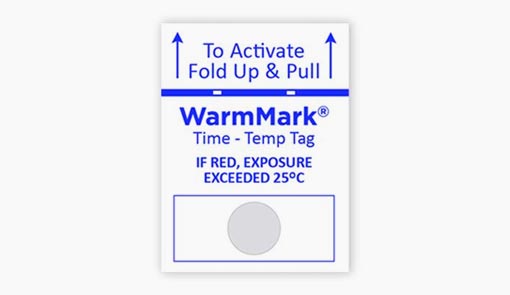
WarmMark indicators, developed by specialised thermal monitoring companies, introduce a complementary solution. They are irreversible chemical labels that change colour when a product exceeds a specific temperature for a defined period of time.
Their operation is simple:
- they are activated before shipment
- they are placed on the product packaging
- they change colour if the thermal threshold is exceeded
This allows visual detection of whether chocolate temperature control has been maintained throughout the entire journey.
Currently, these indicators are used across multiple sectors, from pharmaceuticals to food, especially for heat‑sensitive products.
The use of WarmMark indicators is having a growing impact on chocolate logistics. Companies use them as an additional layer of security to verify thermal conditions during transport.
When the indicator shows an activation — usually visible through a red signal — it means the product has exceeded the temperature limit. This makes it possible to identify logistical incidents and take rapid decisions regarding product distribution.
In the chocolate sector, these tools help to:
- detect failures in the food cold chain
- prevent compromised products from reaching the market
- improve chocolate temperature control during transport
- strengthen logistics audits
In addition, the information obtained can be used to optimise routes, improve insulated packaging or review storage protocols.
From a quality perspective, chocolate temperature control affects not only the product’s appearance, but also its texture, gloss, stability and cocoa butter behaviour — key factors in consumer perception.
Various food industry associations have highlighted the importance of reinforcing thermal monitoring systems for heat‑sensitive products.
Organisations linked to food safety and logistics note that tools such as food temperature sensors and WarmMark indicators help improve transport traceability.
The adoption of these systems also responds to increasing regulatory pressure regarding quality and food safety. International regulations related to good distribution practices recommend maintaining verifiable controls over transport conditions.
Chocolate temperature control has therefore become a priority for manufacturers, distributors and logistics operators, especially on international routes or in warm‑climate regions.
The sector expects the use of thermal monitoring technologies to continue growing in the coming years. The combination of WarmMark indicators, digital sensors and logistics tracking systems could become the standard in chocolate logistics.
In addition, rising temperatures associated with extreme climate phenomena are driving new solutions for thermal food control, including intelligent packaging and real‑time data analysis systems.
For manufacturers, ensuring chocolate temperature control is not only a matter of quality, but also of brand reputation. A product that arrives melted or deformed can generate economic losses and damage consumer trust.
For this reason, the industry continues investing in tools that allow monitoring every stage of transport and ensuring that chocolate reaches the market under optimal conditions.
In this scenario, WarmMark indicators are emerging as a simple, environmentally friendly yet effective solution to reinforce chocolate temperature control, improve logistics traceability and protect the quality of one of the most heat‑sensitive products in the food industry.



CONTACT US
We are characterised by our attention, flexibility, speed and delivery reliability. The best personalised service with a reliable supplier for regular deliveries.